

Dedicated WordPress Developer in 2026: The True Cost of Freelancer vs In House vs Dedicated
By Saumya Patel | Content Writer | 4+ Years of Industry Experience | Last Updated: June 12, 2026
Quick Answer
A dedicated WordPress developer is a professional assigned exclusively to your business on a monthly engagement — combining a freelancer’s flexibility with an in-house hire’s reliability. The right choice isn’t about hourly rate; it’s about total cost of ownership over 12–24 months. A $500–1,500/month dedicated developer often beats both a cheap freelancer (rework, technical debt) and a full-time hire (~$8K+/month fully loaded) for most small and mid-sized businesses.
Every article on this topic answers the wrong question — “how much per hour?” — when the question that actually decides your cost is “what will this model cost me over two years, including the mistakes?”
This guide reframes the decision around true cost of ownership, with real 2026 numbers and a proprietary tool — the Developer Model Fit Score — so you choose the model that fits your business, not the one with the lowest sticker price. If you want a dedicated developer, explore our WordPress development services.
What Is a Dedicated WordPress Developer?
A dedicated WordPress developer is a professional assigned exclusively to your business or project on a structured full-time, part-time, or monthly engagement. Unlike a freelancer juggling many clients, they learn your goals, maintain consistent communication, document their work, and provide ongoing support — combining outsourcing’s flexibility with the reliability of a team member.
The defining trait is exclusivity plus continuity: the same person stays with your codebase over time, so context compounds instead of resetting with every new hire. That continuity is exactly what prevents the hidden costs we quantify below.
The Real 2026 Numbers: What Each Model Costs
Hourly rates are only the visible tip. Here’s the 2026 landscape across models:
| Model | Typical 2026 Cost | Best For |
|---|---|---|
| Freelancer (Marketplace) | ~$20–$80/hr; vetted $80–$120/hr | Small, clearly-scoped one-off tasks |
| Freelancer (Senior/Expert) | $95–$250+/hr | Complex builds with a defined scope |
| In-House (Full-Time) | $60K–$120K salary; ~$95K–$130K+ all-in year one | Constant, daily product work |
| Dedicated Developer | ~$500–$1,500+/mo (part-time) to full-time retainer | Ongoing work + long-term consistency |
The revealing comparison: a business needing about 20 hours a month pays roughly $500–$1,500/month with a dedicated or freelance model versus ~$8,000+/month fully loaded for an in-house hire. A full-time developer only pays off with enough work to keep them busy year-round.
The True Cost of Ownership (Tarasaka Framework)
Sticker price lies because it ignores what happens after the invoice. True cost of ownership adds three things every cheap option quietly generates:
| Cost Layer | What It Includes | Who It Hits Hardest |
|---|---|---|
| Visible Cost | Hourly rate or salary | Everyone (the only thing most compare) |
| Efficiency Cost | Utilization gaps, meetings, bench time, recruitment | In-house (billable utilization often 60–75%) |
| Failure Cost | Rework, technical debt, downtime, lost leads, rebuilds | Cheap freelancers & patchwork teams |
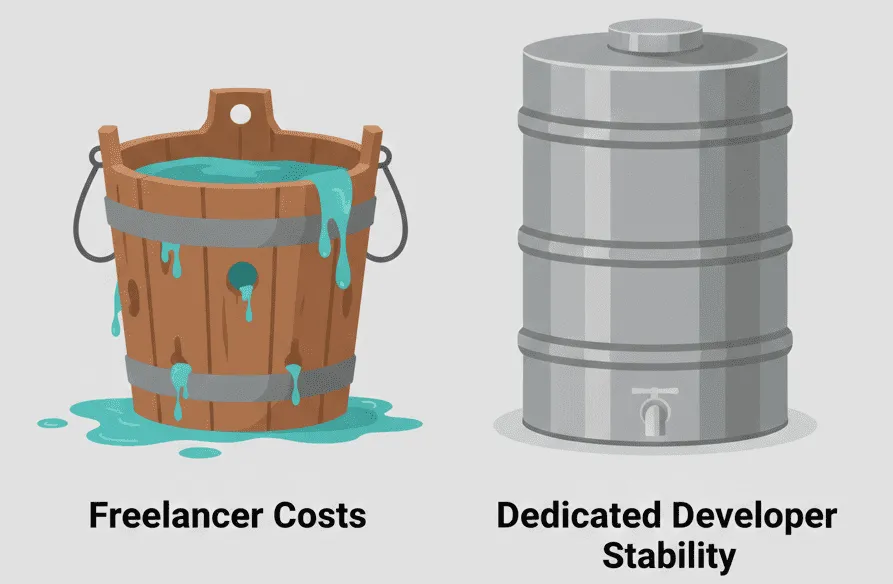
The principle: cheap development is a loan — you repay it later with interest, as rebuilds and lost revenue. The real cost of a WordPress developer shows up months later in performance issues, lost traffic, and missed growth, not on the first invoice.
The Hidden Cost of the Cheap Freelancer
Freelancers aren’t bad — many are excellent. But the model carries failure-cost risk: availability gaps when they juggle clients, no backup if they vanish, thin documentation that stalls scaling, and patchwork architecture when several freelancers touch the site over time. Each creates indirect cost — lost leads, downtime, technical debt, redesigns — that often erases the upfront savings.
The Hidden Cost of In-House
In-house feels safe but carries heavy efficiency cost. Beyond salary you pay benefits, hardware, tools, training, and recruitment — and developers rarely bill 100% of their hours to revenue work. Meetings, internal tasks, and slow periods drop real utilization to 60–75%. You’re paying full-time for part-time output unless you have constant work.
Freelancer vs In-House vs Dedicated: The Decision Breakdown
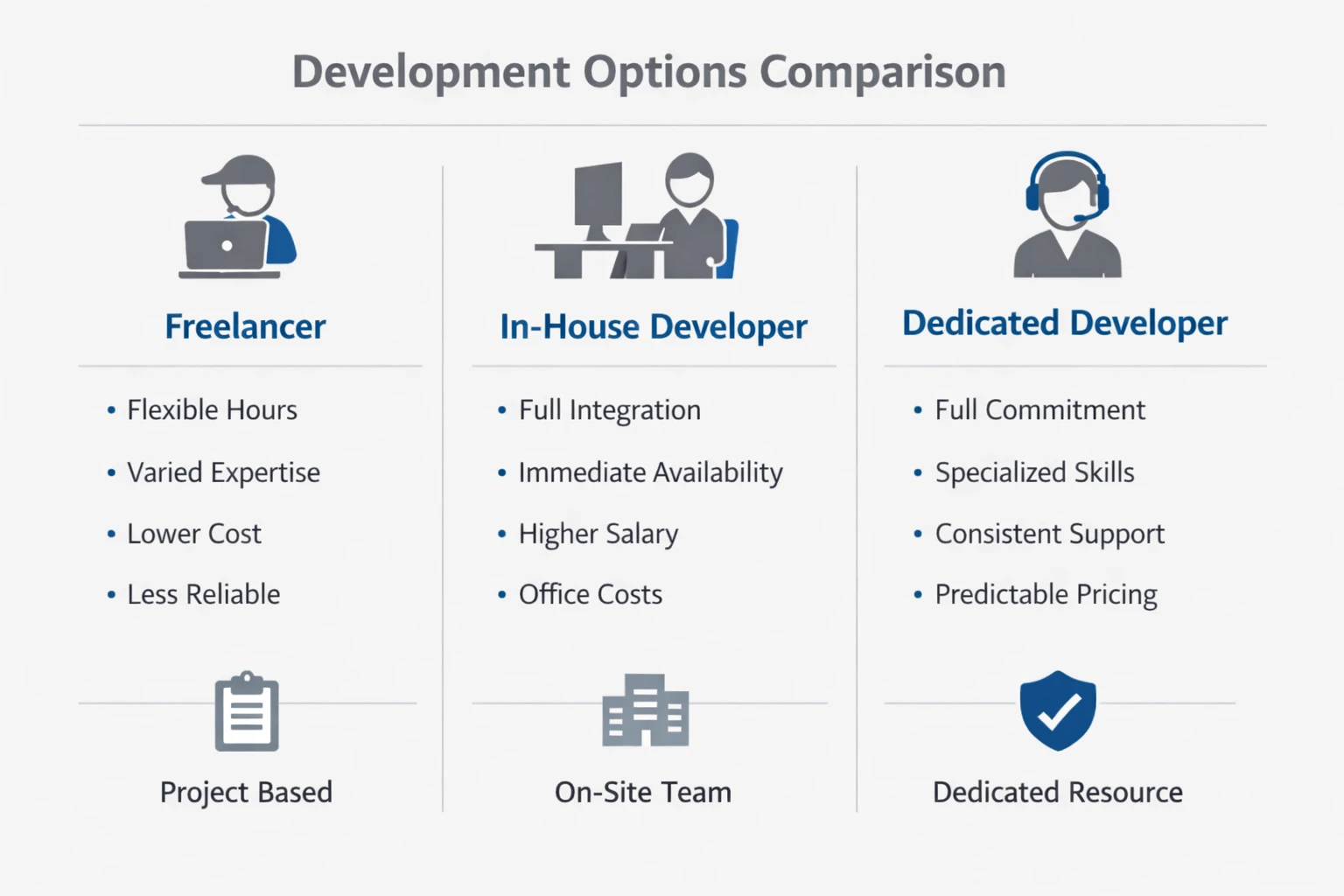
| Factor | Freelancer | In-House | Dedicated |
|---|---|---|---|
| Upfront Cost | Lowest | Highest | Predictable Monthly |
| Availability | Variable | High | High (Reserved Time) |
| Backup / Continuity | Weak | Strong | Strong |
| Documentation | Inconsistent | Depends | Structured |
| Scalability | Limited | Slow (Hiring) | Flexible |
| Overhead / HR | None | Heavy | None |
The Developer Model Fit Score (Choose in 60 Seconds)
Score each factor for your situation, then read the result:
- Work volume: constant daily work (in-house) → steady monthly (dedicated) → occasional (freelancer).
- Scope clarity: one clear project (freelancer) → evolving roadmap (dedicated/in-house).
- Continuity need: high — the site is a core asset (dedicated/in-house) → low, one-off (freelancer).
- Budget structure: want predictable monthly cost with no HR overhead (dedicated) → can carry full salary + benefits (in-house).
The pattern: occasional + clearly-scoped → freelancer; constant daily product work + budget for overhead → in-house; ongoing work that needs consistency without HR cost → dedicated. For most small and mid-sized businesses, that middle path wins.
How a Dedicated Developer Improves Performance (and Revenue)
Development isn’t just design — it’s the structure that determines whether traffic converts. A dedicated developer compounds value across four areas:
- Clean code structure: prevents plugin conflicts and future rework.
- Speed / Core Web Vitals: faster pages lift both rankings and conversions.
- SEO-friendly architecture: schema, internal linking, and clean URLs improve organic visibility.
- Conversion optimization: clear user flow turns visitors into inquiries.
Expert insight: if your WordPress site gets traffic but few leads, the problem is usually structural, not your marketing. No ad budget fixes a slow, poorly-architected site.
“WordPress Developer Near Me” vs Remote Expertise
Should I hire a local or remote WordPress developer?
Direct answer: In 2026, process quality matters more than proximity. Structured remote collaboration — clear communication, defined timelines, documented work, ongoing support — delivers the same or better results than a local hire, without paying a premium for the zip code. Local can help for in-person discussion, but geography no longer determines quality.
Searches like “WordPress developer near me” or “WordPress expert in Ahmedabad” assume proximity guarantees quality — it doesn’t. For Ahmedabad businesses (Satellite, Navrangpura, Prahlad Nagar, Thaltej, Gota), local collaboration adds convenience, but a structured remote engagement widens the talent pool without escalating cost. Judge on process, not postcode.
When Should You Hire a Dedicated WordPress Developer?
Consider the dedicated model when:
- Your site speed is below industry benchmarks (Core Web Vitals failing).
- Plugin conflicts or breakages happen frequently.
- Your WooCommerce store needs scaling or performance work.
- You’re redesigning for better conversions.
- You need ongoing SEO technical support.
- You (or your agency) manage multiple client websites.
For Agencies: The White-Label Dedicated Model
Agencies gain the most from dedicated, white-label WordPress developers. Instead of coordinating a rotating cast of freelancers, an agency gets brand-consistent delivery, faster turnaround, structured client reporting, and the ability to scale output without adding internal headcount or HR overhead. It converts unpredictable freelance capacity into reliable, resellable delivery.
Common Misconceptions
- “Freelancers are always cheaper.” Short-term, often. Over 12–24 months, rework and technical debt frequently make them the most expensive option.
- “In-house gives more control.” Control comes from structure and documentation, not physical location. A well-run remote engagement can be more controlled than a busy in-house dev.
- “Remote means unreliable.” In 2026, structured communication and project systems make remote as dependable as in-house — often more, because the work is fully documented.
The Bottom Line
The cheapest hourly rate is rarely the cheapest outcome. Freelancers win for occasional, clearly-scoped tasks; in-house wins when you have constant daily work and a budget for overhead; the dedicated model wins for most businesses that treat their website as a long-term asset — predictable cost, structured support, and continuity without HR burden.
Stop comparing hourly rates. Compare true cost of ownership over two years, and choose the model that fits your work not the one with the lowest sticker price.
Not sure which developer model fits your business?
Get a free consultation from Tarasaka and a true-cost comparison for your project.