
We now offer Free AI Visibility Audits. find out if ChatGPT, Perplexity & Google AI can find your business. Claim yours →
Law Firm SEO vs PPC: Which Generates More Legal Clients in 2026
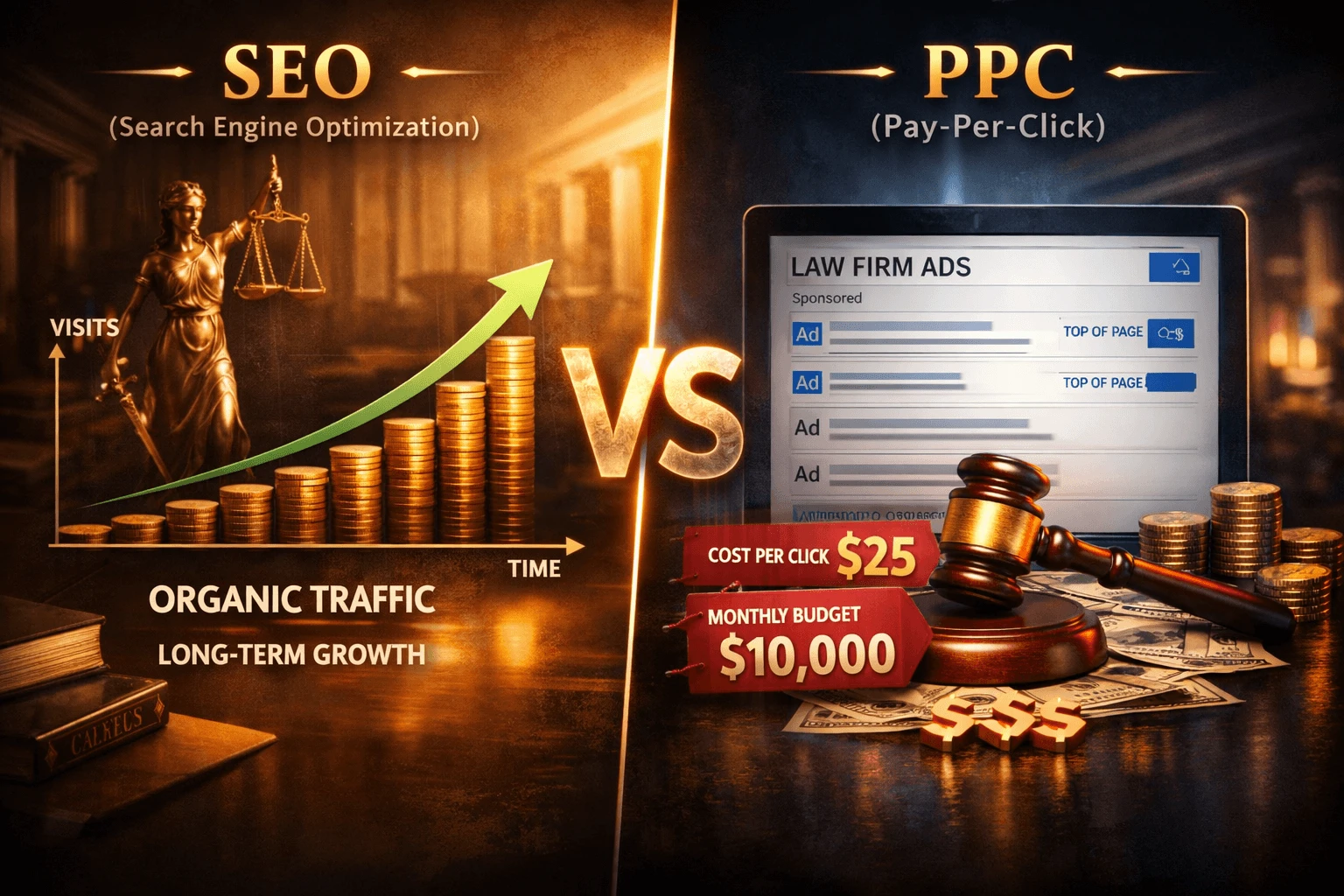
Law Firm SEO vs PPC in 2026
The Complete Guide to Costs, ROI, and AI Search
Saumya Patel | Content Writter | 4+ Years of Industry Experience |
Last Updated: June 10, 2026 | 17 Min Read
Quick Answer
For most law firms in 2026, SEO delivers a lower cost-per-lead and higher long-term ROI, while PPC delivers immediate leads at the highest cost-per-click of any industry. The winning approach combines both — PPC for speed, SEO for compounding returns — and adds GEO (Generative Engine Optimization) so your firm is cited inside AI answers. Your ideal mix depends on your timeline, case value, and monthly budget.
The 30-Second Verdict
| If your priority is… | Lead with… |
|---|---|
| Signed cases this month | PPC |
| Lowest cost per case over 1–3 years | SEO |
| Visibility in AI Overviews & ChatGPT | SEO + GEO |
| “Lawyer near me” / local dominance | Local SEO + Map Pack |
| Predictable, scalable growth | All channels, sequenced |
Every law firm faces the same question when the marketing budget lands: pour it into Google Ads for leads today, or invest in SEO for leads that compound for years? Choose wrong and you either burn thousands on unqualified clicks or wait months for traffic that never converts.
This guide answers that question with real 2026 cost data, modeled budget scenarios, channel timelines, and the one shift most firms still haven’t priced in: AI is now answering legal searches before anyone clicks. Let’s start with how each channel actually works — then make the decision concrete.
How Law Firm SEO Actually Works
How does law firm SEO work?
Quick answer: Law firm SEO improves your visibility in unpaid (organic) search results. You optimize your website’s content, technical health, local presence, and authority so Google ranks your pages for queries like “personal injury attorney near me.” Once a page ranks, it generates leads continuously with no per-click cost.
Modern legal SEO is not keyword stuffing. It is a layered system, and each layer maps to entities Google evaluates when deciding whether to trust a law firm in a high-stakes (YMYL) category:
- On-page & content: practice-area pages, city pages, and deep guides that match how clients actually search, marked up with schema (Attorney, LegalService, FAQPage).
- Local SEO: your Google Business Profile, NAP consistency (name, address, phone), the Local Pack / Google Maps ranking, attorney reviews, and listings on legal directories like Avvo, Justia, and FindLaw.
- Technical SEO: site speed, mobile usability, crawlability, and structured data so search engines and AI models can parse your pages cleanly.
- Authority (E-E-A-T): named attorney authorship, credentials, citations, and earned links that signal experience, expertise, authoritativeness, and trust.
The economics are front-loaded. You invest heavily for roughly 12–14 months, then cost-per-case falls as ranking pages keep producing leads without new spend. That compounding is SEO’s defining advantage — and we’ll quantify it below.
How Law Firm PPC Actually Works
How does PPC work for law firms?
Quick answer: Law firm PPC (pay-per-click) is paid advertising — primarily Google Ads and Local Services Ads — that places your firm at the top of results for chosen keywords. You bid in an auction and pay each time someone clicks, whether or not they hire you. Visibility is instant but stops the moment you pause spending.
PPC for law firms runs across a few surfaces: standard Search Ads (text ads above organic results), Local Services Ads (the “Google Screened” pay-per-lead units at the very top of local legal searches), and remarketing. Success depends on tight keyword targeting, negative keywords, Quality Score, and — critically — dedicated landing pages that match each ad’s promise.
The catch is price. Legal is the single most expensive vertical in paid search, and costs are still climbing. The next sections put hard numbers on exactly how much.
The 2026 Shift: AI Overviews, Zero-Click Search & GEO
Search itself changed. It’s no longer just blue links you rank in (SEO) or buy above (PPC). A growing share of legal searches are answered on the results page by AI — and legal leads every industry in how often this happens.
The data: As of late 2025, 77.67% of legal search queries trigger Google AI Overviews — the highest rate of any industry — and roughly 58% of all Google searches now end without a click. Google’s March 2026 core update hit legal especially hard, with 55% of affected sites losing 20–35% of organic traffic.
What is GEO for Attorneys?
Quick answer: GEO (Generative Engine Optimization), also called AEO or LLM optimization, is the practice of structuring your firm’s content so AI systems — Google AI Overviews, ChatGPT, Gemini, and Perplexity — cite and recommend your firm when potential clients ask legal questions. It is an extension of strong SEO, not paid advertising.
GEO matters because the audience is real and growing: LLM-referred traffic to legal websites more than doubled between early 2024 and mid-2025. And it works — research from Princeton and Georgia Tech found GEO strategies deliver about 40% better visibility than traditional SEO approaches. The key point for this comparison: authoritative, well-structured content is what AI engines cite, so GEO favors SEO investment. PPC buys you nothing inside an AI answer.
SEO vs PPC: Side-by-Side Comparison
Table 1 — The Fundamentals
| Factor | SEO | PPC |
|---|---|---|
| Upfront cost | Higher (content, technical, authority) | Lower to start |
| Ongoing cost | Falls per lead over time | Constant — pay every click |
| Speed to first lead | 3–6 months | Days |
| Lead intent / quality | High (active searchers) | Mixed (targeting-dependent) |
| Durability | Compounds; survives a pause | Stops instantly when budget ends |
| AI-search visibility | Strong (feeds GEO / AI Overviews) | None |
| Trust signal | Organic results trusted more | Labeled “Ad” — lower trust |
Table 2 — The Economics (2026 Legal Benchmarks)
| Metric | SEO | PPC |
|---|---|---|
| Cost per lead | Lower long-term (compounds) | $131.63 avg (highest of any industry) |
| Lead-to-client conversion | 14.6% | 3.75% |
| 3-year ROI | 526% avg | Varies; erodes as CPC rises |
| Break-even | ~14 months | Immediate, then ongoing |
| Cost trend | Cost-per-case falls over time | Rising (+12.9% YoY) |
Table 3 — Snippet View
| Metric | SEO | PPC |
|---|---|---|
| Speed | Slow | Fast |
| Cost per lead | Lower | Higher |
| Long-term ROI | High | Medium |
| AI visibility | High | Low |
Law Firm Marketing Statistics 2026
- 77.67% of legal search queries trigger Google AI Overviews — the highest of any industry (Dec 2025 study).
- ~58% of Google searches now end without a click to any website.
- $8.58 average cost-per-click for legal keywords — the highest of any industry, up 12.9% year-over-year (WordStream 2025).
- $131.63 average cost-per-lead for attorneys and legal services vs. a $5.26 cross-industry average click (WordStream 2025).
- $1,540 per click for “drunk driving accident lawyer Houston”; 19.4% of Google’s 5,000 priciest keywords are legal terms.
- 526% average 3-year SEO ROI for legal services, with a ~14-month break-even and 6.15 ROAS (First Page Sage 2025).
- 14.6% vs 3.75% — SEO leads convert to clients about 4x better than paid-search leads (GrowLaw 2025).
- 66% of call conversions in legal come from organic search; 94% of firms call search their top brand-awareness channel.
- 45% — the average share of a law firm’s digital budget allocated to SEO (the largest single channel).
- 40–60% of PPC spend is wasted on irrelevant searches when firms run broad match with no negative keywords.
Real Budget Examples (Modeled)
Note: These are illustrative planning models built from 2026 legal benchmarks (PI cost-per-lead ~$400; SEO compounding curve). They are projections to guide allocation — not guarantees. Your numbers vary by practice area, market, case value, and execution.
Example: Personal Injury Firm, $5,000/Month
Same budget, two strategies. The difference shows up in Year 2, when SEO’s compounding overtakes flat paid spend.
| Strategy | Year 1 leads/mo | Year 2 leads/mo | Direction |
|---|---|---|---|
| Option 1: 100% PPC ($5k) | ~12 (flat) | ~12 (flat) | Stays flat; cost-per-lead rises |
| Option 2: $2.5k PPC + $2.5k SEO | PPC ~6, SEO ramps to ~4 | PPC ~6, SEO ~10+ | SEO compounds; blended cost falls |
By the end of Year 2, the split-budget firm generates more total leads than the all-PPC firm — and an increasing share arrive at near-zero marginal cost because the ranking pages are already built. The all-PPC firm pays full freight for every single lead, forever, against a CPC that climbs each year.
Sample Budget Allocation by Monthly Spend
| Monthly Budget | PPC / LSAs | SEO + GEO | Local + Content | Best For |
|---|---|---|---|---|
| $2,000 | 55% | 30% | 15% | Solo / new firm needing leads now |
| $5,000 | 40% | 45% | 15% | Growth-stage multi-attorney firm |
| $10,000+ | 30% | 50% | 20% | Scaling firm building a moat |
The Real Law Firm Marketing Funnel
Traffic → Consultation → Signed Client
Leads are not the goal — signed clients are. Every channel feeds the same three-stage funnel, and the channels behave differently at each stage:
- Traffic: PPC buys it instantly; SEO and GEO earn it and compound it; Local SEO captures “near me” intent.
- Consultation: Intake speed and landing-page quality decide conversion here. A $181 click wasted on a slow, generic homepage never becomes a consult.
- Signed client: This is where intent wins — organic leads convert at 14.6% vs 3.75% for paid, because searchers who find you organically arrive with higher trust.
The lesson: Cheap traffic with broken intake loses to slightly costlier traffic that converts. Optimize the whole funnel, not just the click.
What to Expect: SEO vs PPC Timelines
SEO Timeline
| Phase | What Happens |
|---|---|
| Month 1–3 | Technical audit, Google Business Profile, schema, pillar + practice-area pages built. Little traffic yet. |
| Month 4–6 | Content velocity and links kick in; first rankings and early organic leads appear. |
| Month 7–12 | Rankings compound; lead volume climbs toward the ~14-month break-even. |
PPC Timeline
| Phase | What Happens |
|---|---|
| Week 1 | Campaigns built, landing pages live, ads launched — first clicks and calls within days. |
| Week 2 | Negative keywords and bid adjustments cut wasted spend; Quality Score starts improving. |
| Week 4 | Stable, predictable lead flow at a known cost-per-lead. |
Local SEO vs PPC for “Lawyer Near Me” Searches
Is SEO or PPC better for “lawyer near me” searches?
Quick answer: For sustained local visibility, Local SEO wins. Ranking in the Google Local Pack and Maps through an optimized Google Business Profile, consistent NAP citations, and strong reviews generates clicks at no per-click cost. PPC and Local Services Ads add immediate top placement but stop producing the moment you pause spending.
Most legal clients search locally, so this layer is often the highest-ROI battleground. The entities that decide local rankings:
- Google Business Profile: complete, categorized, with photos, practice areas, and regular posts.
- Reviews: volume, recency, and responses — a primary local ranking and conversion factor.
- NAP consistency & citations: identical name, address, phone across the web and directories.
- Legal directories: Avvo, Justia, and FindLaw profiles reinforce relevance and feed trust signals.
- Local Services Ads: the pay-per-lead “Google Screened” units — a useful PPC complement for instant local presence.
Which Should Your Firm Choose? A Decision Framework
Answer three questions to find your starting point:
- How fast do you need leads? This month → start PPC. Next quarter is fine → start SEO.
- What’s your average case value? High (PI, mass tort) → premium CPCs can still pencil out. Low (immigration, family) → SEO is far more sustainable.
- Can you fund consistently for 12+ months? Yes → build the SEO + GEO foundation. Short burst only → PPC, knowing it stops when the money does.
When should a law firm hire an SEO or marketing agency?
Quick answer: Hire an agency when your time is worth more than the work, when in-house results have plateaued, or when you need technical SEO, GEO, and local optimization executed together. The right time is usually before a growth push — SEO’s ~14-month curve means the earlier you start, the sooner it compounds.
What Legal PPC Costs by Practice Area (2026)
Averages hide huge variance. Budget by your practice area, not a blended number:
| Practice Area | Typical CPC | Typical Cost Per Lead |
|---|---|---|
| Personal injury | $50–$150+ | $312–$512 by case type |
| Mass tort / mesothelioma | $250–$1,000+ | Very high |
| Criminal defense | $15–$70 | Moderate |
| Family law | $8–$35 | Moderate |
| Immigration | $6–$20 | Lower |
Personal-injury cost-per-lead by case type runs roughly: auto accident $391, slip and fall $312, workplace injury $354, product liability $476, and medical malpractice $512. A six-figure case can justify a $500 lead; a $1,500 immigration matter cannot — which is exactly why the answer to “SEO or PPC” changes by practice area.
Common Mistakes That Waste Legal Marketing Budget
- Sending PPC clicks to a generic homepage instead of a matched landing page.
- Running broad match with no negative keyword list (40–60% wasted spend).
- Treating SEO as keyword stuffing instead of E-E-A-T-driven authority.
- Ignoring AI Overviews and GEO — optimizing for a click that increasingly doesn’t happen.
- Skipping the Google Business Profile and reviews while paying for clicks.
- Measuring rankings and clicks instead of signed cases.
The Winning Play: Sequenced SEO + PPC + GEO
The strongest firms don’t pick a side — they sequence the channels:
- Month 1: Launch tightly targeted PPC + Local Services Ads for immediate cases, with a full negative-keyword list.
- Months 1–12: Build the SEO + GEO + Local foundation in parallel — pillar pages, practice-area guides, GBP, schema, and E-E-A-T content AI engines cite.
- Months 12+: As organic cost-per-acquisition drops below paid, shift budget from PPC into SEO/GEO. Keep PPC for launches and high-value bursts.
Free Tools to Plan Your Firm’s Strategy
Use these to turn this guide into a concrete plan:
- SEO Cost Calculator — “What will SEO cost my law firm?” Estimate investment and projected break-even by practice area and market.
- ROI Estimator — Model SEO vs PPC leads and revenue over 24 months using your own case values.
- 2026 Law Firm Marketing Checklist — A downloadable audit covering SEO, PPC, Local, and GEO / AI-search readiness.
The Bottom Line
If you need cases this week, PPC works — at a price that keeps climbing. If you want predictable, defensible, lower-cost growth, SEO is the foundation, and GEO keeps that foundation visible as AI reshapes search. Local SEO wins the “near me” battle most firms live or die on.
The firms winning in 2026 stopped asking “SEO or PPC?” They built a system where paid search opens the door, organic search compounds, local SEO owns the map, and AI engines name them as the answer.
Data sources: WordStream / LocaliQ 2025 Google Ads Benchmarks; First Page Sage SEO ROI data (2025); GrowLaw (2025); industry CPC analyses; December 2025 AI-search studies (AI Overview trigger rate, LLM referral growth); Princeton / Georgia Tech GEO research. Current as of 2026 — verify against live sources before publishing. Budget figures are illustrative planning models, not guarantees.
Editorial Note: This article is based on research from industry publications, official platform documentation, and publicly available data. Information is current as of the publication date and may change as search engines, AI platforms, and advertising systems evolve.
Is SEO cheaper than PPC for law firms?
Over time, yes. SEO has a higher upfront cost but a falling cost-per-lead, while PPC charges for every click indefinitely — and legal CPCs average $8.58, the highest of any industry. Most firms hit SEO break-even around 14 months, after which leads cost far less than paid.
How long does law firm SEO take to work?
Most firms see measurable gains in 3–6 months and break even around 14 months, depending on competition, practice area, and site condition. Returns then compound as ranking pages keep generating leads without new per-click spend.
Will AI Overviews kill my SEO traffic?
They reduce raw clicks — about 58% of searches now end without one, and legal triggers AI Overviews more than any vertical. But strong, authoritative content is exactly what AI engines cite, so well-executed SEO becomes the path to AI visibility rather than a casualty of it.
How do I get my law firm cited by ChatGPT or Google AI Overviews?
Through GEO: structured, jurisdictionally clear, E-E-A-T-aligned content with named attorney authorship, clear entities (firm, city, practice area), and direct answers to real client questions. It’s an extension of good SEO, not paid advertising.
Which is better for "lawyer near me" searches?
SEO plus local optimization (Google Business Profile, Map Pack) wins long-term local visibility; Local Services Ads and PPC add immediate top placement. For sustained “near me” presence, organic and local SEO are the foundation.
Should a new firm start with SEO or PPC?
Start PPC for immediate cases, but begin building SEO and GEO in parallel from day one. Relying on PPC alone in legal is financially punishing given CPCs; relying on SEO alone means months with no leads. Sequence both.
What's the best marketing strategy for law firms in 2026?
A sequenced mix: PPC for speed, SEO for compounding low-cost leads, and GEO to stay visible inside AI-generated answers. The exact ratio depends on your timeline, case value, and budget stability.

Saumya Patel
Saumya Patel is a Content Writer at Tarasaka with over 4 years of experience creating SEO-focused content for businesses across multiple industries. Her areas of expertise include SEO, Local SEO, AI SEO, AEO (Answer Engine Optimization), GEO (Generative Engine Optimization), content strategy, and digital marketing.
At Tarasaka, Saumya researches search trends, analyzes ranking factors, studies AI search behavior, and creates evidence-based content designed to help businesses improve online visibility, attract qualified leads, and build long-term organic growth. His content is developed using industry best practices, competitor analysis, and real-world search marketing insights to ensure accuracy, relevance, and practical value for readers.
Facebook
X
LinkedIn
WhatsApp
Recent Post



Ready to Dominate Local Search for Your Brand?
Book a free 30-minute audit — we'll show you exactly where visibility is being lost and how to win it back.
- 100% Free
- No Credit Card
- No Obligation