
We now offer Free AI Visibility Audits. find out if ChatGPT, Perplexity & Google AI can find your business. Claim yours →
Law Firm SEO Guide: How Lawyers Rank #1 on Google
Representative results from a client engagement. Identity protected by NDA.
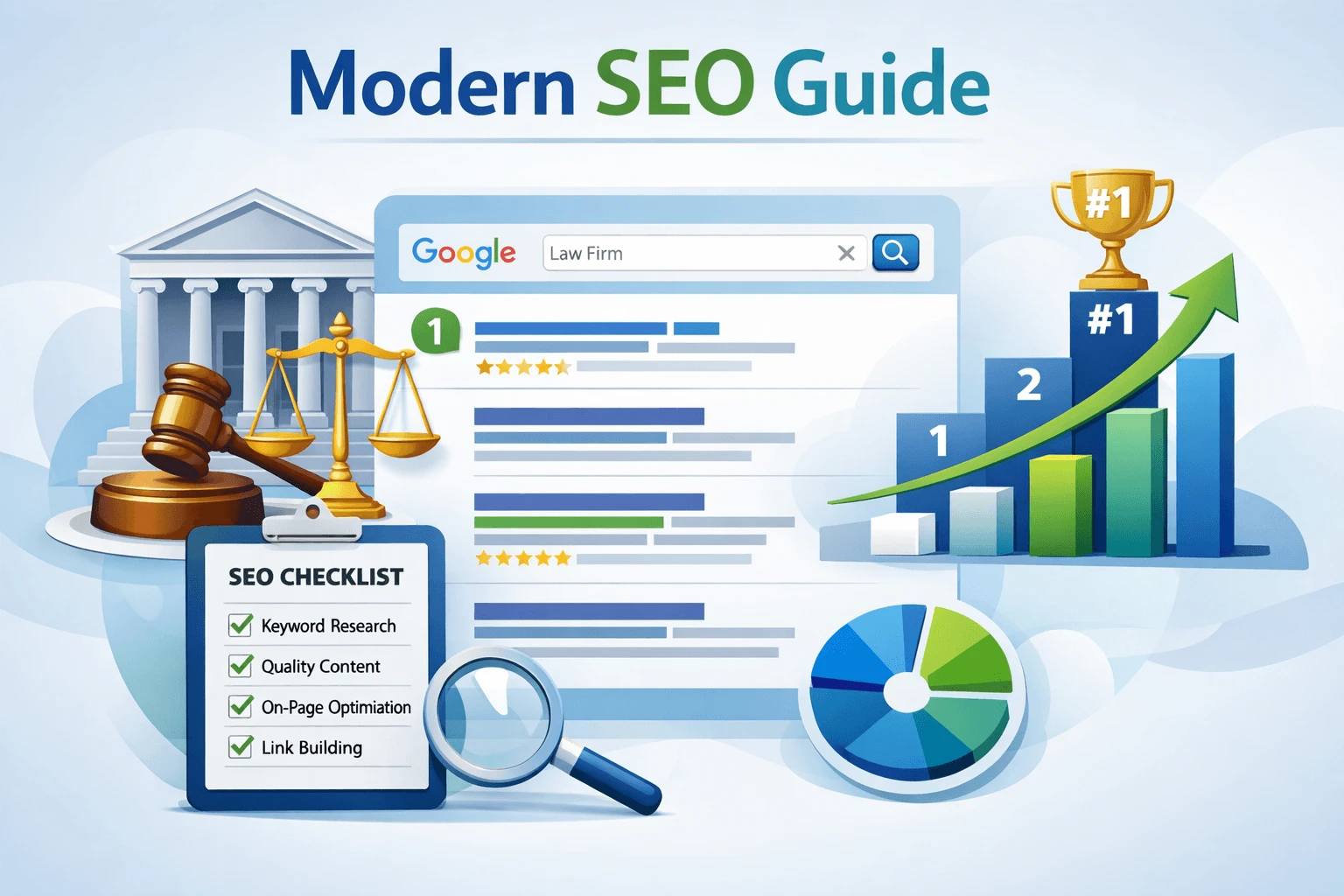
Law Firm SEO in 2026
The Complete Guide to Ranking for Cases, Not Just Traffic
By Saumya Patel | Content Writer | 4+ Years of Industry Experience | Last Updated: June 11, 2026 | 18 Min Read
Law firm SEO is the process of optimizing your website, content, and local presence so your firm appears when potential clients search for legal help. In 2026 it works on four layers — technical foundation, practice-area relevance, E-E-A-T authority, and AI visibility — and the firms that win sequence them in that order. Done right, a top-three ranking can be worth $15,000–$30,000/month in equivalent ad value, at zero cost per click.
Most law firm SEO guides are encyclopedias: they list every tactic and leave you to guess what matters. This one is different. We reverse-engineered the guides currently ranking on page one, kept what makes them rank, and added the one thing they all lack — a clear order of operations.
The result is a prioritized system — the Legal SEO Pyramid — plus a keyword matrix and a practice-area page blueprint you can act on this week. If you want this implemented for you, explore our law firm SEO Miami services.
What Is Law Firm SEO?
What is law firm SEO?
Law firm SEO is the practice of improving a law firm’s website, content, technical health, and local presence so it ranks in Google’s organic results for the legal services potential clients search for — like “personal injury lawyer Miami.” Unlike paid ads, it builds visibility that keeps generating leads without paying per click.
Critically, law firm SEO is not generic SEO applied to a legal site. Google classifies legal content as YMYL (Your Money or Your Life), which means it is held to a far higher bar for accuracy, expertise, and trust. That single fact shapes every strategy below.
Why SEO Matters for Lawyers (The Real Numbers)
Legal SEO isn’t a vanity project — it is client acquisition math. Four reasons it outperforms most other channels:
- Demand starts with search: About 96% of people seeking legal advice begin with an online search (National Law Review). If you’re not visible, you’re not considered.
- Organic out-clicks ads: Roughly 45%+ of users click organic results versus about 1.8% on ads — and legal keywords are the most expensive in Google Ads, averaging $8.58 per click.
- The intent is pre-qualified: Someone searching “criminal defense attorney near me” already needs help. SEO leads convert to clients at roughly 14.6% versus 3.75% for paid-search leads.
- It compounds: A top-three ranking can be worth $15,000–$30,000/month in equivalent ad value at zero ongoing cost per click, and keeps producing after the work is done.
The Legal SEO Pyramid (Tarasaka Framework)
Here’s what competitor guides miss: SEO factors are not a checklist — they’re a hierarchy. Each layer depends on the one beneath it. Build in this order and nothing is wasted; build out of order and you spend money on authority Google won’t even see.
| Layer | Sequence | Covers | Why It Sits Here |
|---|---|---|---|
| 1. Foundation | First | Technical SEO, Google Business Profile, NAP, the Map Pack | Nothing ranks if Google can’t crawl or trust the basics; local is where legal intent lives. |
| 2. Relevance | Second | Practice-area pages, hiring-intent keywords, location pages | Tells Google exactly which cases you want to win. |
| 3. Authority | Ongoing | E-E-A-T, attorney authorship, reviews, backlinks, directories | YMYL demands proven trust before Google will rank you. |
| 4. AI Visibility | Top Layer | GEO / AEO, structured answers, schema, entity consistency | Wins citations in AI Overviews and assistants once layers 1–3 are solid. |
The principle: Foundation earns the right to rank, relevance earns the ranking, authority defends it, and AI visibility extends it. Skipping a layer is the most common — and expensive — mistake in legal SEO.
Layer 1: Foundation — Technical Health + Local
Your site must load fast, work on mobile, and be cleanly crawlable. Then comes the highest-leverage local asset: a complete Google Business Profile (correct categories, services, hours, photos, posts, Q&A) with consistent NAP — name, address, phone — everywhere online. This is what earns a spot in the Google 3-pack / Map Pack, where most “near me” legal searches convert.
Layer 2: Relevance — Practice-Area Pages + Hiring-Intent Keywords
Practice-area pages are the cornerstone of legal SEO — every ranking guide agrees, because they tell Google precisely what you do. One strong page per service (and per location you serve) beats a single homepage stuffed with city names. Pair them with hiring-intent keywords, not traffic keywords (more on the matrix below).
Layer 3: Authority — E-E-A-T, Reviews, Links
Because legal is YMYL, Google scrutinizes who is behind the content. Real attorney authorship, verifiable credentials, a steady flow of genuine client reviews, and backlinks from trusted legal directories (Avvo, Justia, FindLaw) and publications are what separate firms that rank from firms that merely exist online.
Layer 4: AI Visibility — GEO / AEO
AI Overviews now dominate the top of many legal results, and clients increasingly consult ChatGPT and Perplexity before they ever call. The good news: Google has confirmed the same SEO fundamentals apply in AI Overviews and AI Mode — indexed, snippet-eligible, helpful pages can appear there with no special markup. Structure content as clear question-and-answer blocks, keep entity data consistent, and Layers 1–3 do most of the work.
The Hiring-Intent Keyword Matrix
Not all keywords are equal. Ranking for high-traffic terms that never sign cases is a waste. Prioritize by how likely the searcher is to become a client:
| Keyword Type | Example | Intent | Priority |
|---|---|---|---|
| Hiring intent | “personal injury lawyer Miami” | Ready to hire | Highest |
| Consultation | “DUI attorney free consultation” | Ready to act | Highest |
| Cost / comparison | “how much does a divorce lawyer cost” | Comparing options | High |
| Problem / situational | “what to do after a car accident in Miami” | Researching, near decision | High (feeds AI) |
| Informational | “how long does a lawsuit take” | Learning | Medium |
The rule: Win hiring-intent and consultation keywords first (they sign cases), then build informational content to establish topical authority and earn AI citations. Most firms do the reverse and wonder why traffic doesn’t convert.
Anatomy of a Practice-Area Page That Ranks (and Gets Cited)
Since practice-area pages are your absolute cornerstone, here is the exact blueprint for a layout that wins both traditional Google rankings and AI snippet extractions:
- A clear H1 + direct answer naming the service and city (“Miami Personal Injury Lawyer”), featuring a 40–60 word summary box right at the top for rich snippets.
- Scope of cases handled: Detail specific case types, rather than vague statements like “we help with injuries.” Specificity builds robust machine entity relevance.
- Process + what to expect: Outline answers to the core procedural questions clients actually ask, framed in accessible, plain language.
- Verifiable Proof: Incorporate financial case results, localized testimonials, and relevant examples (within your local state bar advertising rules) to fulfill E-E-A-T signals.
- Named attorney authorship: Show concrete legal credentials alongside direct internal links to full, comprehensive professional bio profiles.
- An FAQ block targeting long-tail client inquiries, correctly structured behind explicit
FAQPageschema markups. - A highly visible, clear conversion path: Place distinct phone tracking, intake forms, and clear free-consultation CTAs above the fold and repeat them naturally.
- Explicit LocalBusiness / Attorney schema data: Allow search engine algorithms to crawl and parse exactly who you are, what services you provide, and where you operate.
Local SEO and the Google 3-Pack
How do lawyers rank in the Google 3-pack / Map Pack?
Lawyers rank in the Google 3-pack by optimizing their Google Business Profile (accurate categories, services, hours, photos), maintaining consistent NAP citations across the web, and earning a steady stream of genuine client reviews. Proximity, relevance, and prominence are the three signals Google weighs for local results.
For most firms, the Map Pack is the highest-ROI battleground — it sits above organic results and captures “near me” intent. Reviews are both a ranking factor and a conversion factor: volume, recency, and your responses all matter. Learn the mechanics in our guide on how lawyers rank on Google Maps.
E-E-A-T: Why Legal SEO Has a Higher Bar
E-E-A-T stands for Experience, Expertise, Authoritativeness, and Trustworthiness. For YMYL legal content, Google applies heightened scrutiny because bad information can cause real harm.
In practice, that means: name your authors (real attorneys with credentials), cite verifiable legal sources, keep firm and attorney data consistent everywhere, collect and respond to reviews, and never publish thin or duplicated content. E-E-A-T is not a tactic you add at the end — it’s the precondition for ranking at all in legal fields.
Realistic Timeline and Cost
How long does law firm SEO take to work?
Most law firms see measurable results in 3–6 months and reach break-even around 14 months, depending on local competition, website condition, content quality, and backlink strength. SEO is a compounding, long-term system — not a quick fix — and returns accelerate after the foundation is built.
Speed depends on four levers: how competitive your city and practice area are, your site’s current technical health, the quality and velocity of your content, and the strength of your backlink profile. A solo family-law firm in a mid-size market ranks faster than a personal-injury firm in Miami, where competition is fierce.
Common Law Firm SEO Mistakes
- Building off-site authority (Layer 3) before fixing technical and local foundations (Layer 1) — spending on links Google won’t reward yet.
- Relying on one generic homepage instead of dedicated practice-area and location pages.
- Chasing high-traffic informational keywords that never actually sign physical cases.
- Neglecting the Google Business Profile and local reviews while overpaying for PPC ads.
- Publishing unauthored, low-tier generic content in a critical YMYL category that explicitly demands certified expertise.
- Measuring abstract organic traffic numbers instead of phone calls, digital consultation bookings, and signed client cases.
- Expecting major results in a few weeks, then abandoning the strategy right before the compounding curve kicks into effect.
Objections and Misconceptions
- “Is SEO better than Google Ads for lawyers?” They perform different jobs. Paid ads buy immediate, upfront visibility at the highest CPC rates of any major industry; organic SEO compounds long-term into much lower-cost, higher-converting client leads. The strongest firms use PPC for speed while SEO builds a permanent engine underneath.
- “AI Overviews killed legal SEO.” No. Google explicitly confirms the same exact core search fundamentals power AI Overview selections. Authoritative, cleanly structured pages get cited directly there. AI simply eliminated thin SEO tactics in favor of genuine legal authority.
- “SEO gives instant results.” It doesn’t. Plan on 3–6 months to see real keyword traction, and approximately 14 months to hit true financial break-even — followed by years of compounding marketing returns.
How SEO Generates Real Legal Clients
SEO isn’t about abstract traffic — it’s about a functional client-acquisition system. The conversion chain is simple:
The right local individual searches for a lawyer → Finds your firm ranking organically and inside the local Map Pack → Trusts your embedded on-page authority signals → Reads a structured practice-area page tailored exactly to their accident or case type → Converts into a client through a frictionless CTA.
Every single layer of the SEO Pyramid exists entirely to advance an injured person or business owner one step closer to a signed retainer agreement.
The Bottom Line
Law firm SEO in 2026 is the most durable client-acquisition system available to attorneys — but only if you build it in the right order. Foundation earns the right to rank, relevance wins the ranking, authority defends it, and AI visibility extends it. Firms that respect that sequence compound; firms that skip layers stall.
Stop chasing tactics in isolation. Build the Pyramid, win hiring-intent keywords first, and turn your practice-area pages into the most trusted answer in your market.
Data sources: National Law Review (share starting with online search); Rankings.io, GrowLaw, w3era, Esquire Interactive, anandbajrangi.com (page-one ranking-factor analysis); WordStream 2025 (legal CPC); First Page Sage / GrowLaw (SEO ROI and conversion); Google guidance on AI Overviews & AI Mode. Current as of 2026 — verify against live sources.
Editorial Note: This article is based on research from industry publications, official platform documentation, and publicly available data. Information is current as of the publication date and may change as search engines, AI platforms, and advertising systems evolve.
Law firm SEO is the process of optimizing a lawyer’s website, content, technical health, and local presence to rank in Google’s organic results for legal services clients search for. Unlike paid ads, it builds visibility that keeps generating leads without paying per click.
How does SEO help lawyers get clients?
SEO places your firm in front of people actively searching for legal help, where intent is high. Those organic and Map Pack visitors convert far better than paid clicks (about 14.6% vs 3.75%), turning searches into calls, consultations, and signed cases at a lower long-term cost.
How long does it take for law firm SEO to work?
Most firms see measurable results in 3–6 months and break even around 14 months, depending on local competition, website condition, content quality, and backlinks. It compounds after that, generating leads without per-click cost.
What is the most important SEO factor for lawyers?
There isn’t one — it’s a sequence. The foundation (technical health + Google Business Profile) must come first, then practice-area relevance, then E-E-A-T authority, then AI visibility. For local firms, the Google Business Profile and reviews are the single highest-leverage starting point.
Is SEO better than Google Ads for lawyers?
They do different jobs. Ads buy immediate visibility at the highest cost-per-click of any industry; SEO compounds into lower-cost, higher-converting leads over time. Most successful firms run ads for speed while building SEO underneath for durable growth.
Do law firms appear in Google AI Overviews?
Yes — Google confirms the same SEO fundamentals power AI Overviews and AI Mode, and indexed, snippet-eligible, helpful pages can appear there without special markup. Authoritative, well-structured practice-area and FAQ content is what gets cited.

Saumya Patel
Saumya Patel is a Content Writer at Tarasaka with over 4 years of experience creating SEO-focused content for businesses across multiple industries. Her areas of expertise include SEO, Local SEO, AI SEO, AEO (Answer Engine Optimization), GEO (Generative Engine Optimization), content strategy, and digital marketing.
At Tarasaka, Saumya researches search trends, analyzes ranking factors, studies AI search behavior, and creates evidence-based content designed to help businesses improve online visibility, attract qualified leads, and build long-term organic growth. His content is developed using industry best practices, competitor analysis, and real-world search marketing insights to ensure accuracy, relevance, and practical value for readers.
Facebook
X
LinkedIn
WhatsApp
Recent Post